
When we arrive on earth we find a world ready-made. The 'present' is all around us, and the 'future' is yet to come.
But those who have lived a long life have known 'the past' and they are a living library of memories; some sad, some exciting, all important.
We present some of those memories here.

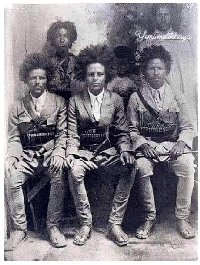
RAS TAFARI HAIRSTYLE
The first known examples of the hairstyle date back to ancient Egypt,
where Locs appeared on Egyptian artifacts. Mummified remains of ancient
Egyptians with locs have even been recovered from archaeological sites.
The Old Testament also recounts the tale of Samson and Delilah in which a man's potency is directly linked to 'the seven locs on his head' and according to Roman accounts, the Celts were described to have 'hair like snakes' Germanic tribes, Greeks and the Vikings are all said to have worn locs too.
Rastafarianism however is something entirely separate. It was born in the 1930s when Ras Tafari was crowned emperor of ????Ethiopia. When the emperor was forced into exile during an invasion, guerrilla warriors swore not to cut their hair until the emperor was reinstated. The religion resonated with the ideologies of the day, for example socialism, Marxism, nationalism and black power. It was therefore, seen as a threat to Christianity and came under attack by the authorities.
STRONG
IN HIS FAITH
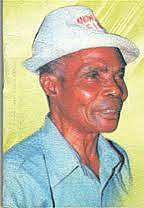
Tai Solarin was a Nigerian icon, a man who dedicated almost his entire
life to activism and rebellion. No contemporary history of Africa's most
populous nation could be complete without mentioning his name. His most
notable contribution was in the field of education, but it was as an indomitable
moral crusader and social critic that he will be remembered. Although
labelled 'atheist' because he would not pray - preferring action - he
was a HUMANIST and was prepared to suffer for his faith in humanity.
He shunned opulence and ostentation. He wore khaki shorts and shirts all the time, regardless of what social function it was.
As Principal of Molusi College, Ijebu-Igbo, in western Nigeria, in 1954, Solarin angered the school’s Board of Governors when he ordered that it was no longer compulsory for students to attend church services. He ordered copies of the Songs of Praise used by the students to be confiscated. If the students could not compose their own songs, then there would be no more singing in school. The students thus created the Melodious Molusian, an unorthodox hymn book.
Though Solarin’s unorthodox style endeared him to the students, who discarded Christian songs that called on God to save them, instead of working hard, the Board was horrified and forced Solarin to resign in January 1955. Undaunted, he established his own school, the Mayflower School, Ikenne, a year later.
The early days of the new school were tough, and he and his English wife Sheila, whom he married while he was a student in Manchester, slept inside mud huts wondering if parents would be brave enough to bring their children to Mayflower, which had by then gained notoriety. Much to their surprise, 1,115 application forms came from prospective candidates from all over Nigeria. Out of these, 70 were admitted as pioneer students.
For many years, TAI SOLARIN was a trouble for IBB; a hard critic of IBB and a perpetual lover of the poor. He called IBB incompetent. So One day, after series of criticisms, IBB invited Tai for a discussion, he asked him what he could do to better the lives of the poor. Tai was happy, he quickly proposed a soft loan for all the poor Nigerians to enable them start small scale businesses and as they return the loans, other poor people will continue to benefit until it reaches all. IBB clapped for Tai and pleaded with him to champion the noble cause so that the programme can run without a hitch. Tai agreed.
Immediately, a Peoples Bank was formed by Decree and huge fund was pumped into it with Dr. Tai as the Chairman. Poor people were getting funds to start or expand their businesses, it was coordinated by Tai, IBB never gave him any bottleneck, no distractions. But after giving out loans to the poor, the poor refused to return the money, neither did we see their businesses on ground, they have spent the money.
Solarin had an immense capacity to shock and to inspire, especially when, in the mid-1970s, he decided to do something about the dead bodies which were often abandoned for days on Nigerian roads. He warned the Nigerian police that if they refused to collect the bodies he would do so himself.
He carried out the threat one day when he collected a body that had been lying for days on a main street in Ibadan. Solarin brought a coffin, poured disinfectant on the body, put it inside the coffin and drove it to the Government Secretariat in Ibadan, and left it at the front door of the office of the Minister of Health. He then left to leak the story to the local newspaper.
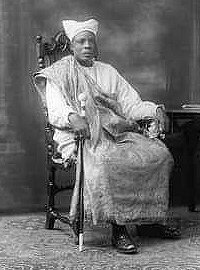
This is Ahmodu Tijani, a direct descendant of the founder of Lagos and Oluwa of Lagos in the 1920's.... He took the British to court in the early 1900's to protest the 1861 treaty of the British with Dosumu, arguing the the representative of the Oba of Benin at no time had rights to the Lands of Lagos and it was not his to give away..... A case he won based on historical evidence showing that the Idejo chiefs of Yoruba descent had always been the landowners of Lagos.....
There is one reason why Yoruba people don't gloat over lands they held historical stakes in but not their ancestral lands..... This is because we are blessed with expanse of lands that are very fertile and a large sea coast.... Even when some of our lands were taken and annexed into other regions, we were still ok with it..... but if we were to talk historically as is being said about Lagos, then Benin and Onitsha both belong to Yoruba people.....
The prince that founded Benin was called Eweka, he was the son of Oranmiyan who once ruled the people of the region. he founded this city because the most important nobility at Igodomigodo was hostile to the new alien dynasty from Ife and refused for him to rule from the main capital. He had to pay them for the right to lease the territory he ruled from. from this new capital, he built a kingdom designed along Yoruba spirituality like Tegbessou of Dahomey did. for many centuries, Benin paid homage to Ife as its source of leadership and spirituality until the arrival of the British. This is is known fact of history before the many interesting revisionist stories natives of Benin engage in today to hide a terrible complex that have about how much they owe the Yoruba people for the advancement as a nation starting from the second dynasty..... Very much like the complex Igbos have at the mention of Ajayi Crowther as the man who brought christainity and exposure to Igbo land.... hsitorically, in Ajayi Crowther's journal, he expressed that before his arrival, Igbos lived in hunger and his expedition had the credit of teaching them how to farm and providing them with seeds.
It was also Ajayi Crowther who built the first school in Igbo land as well as the first church, having brought Christianity to Igbo land... same Ajayi Crwother as a lingustics wrote the first Igbo alphabets and gave them the gift of putting Igbo language into words..... his grandson (Hubert Macaulay) was also the man that would groom Namdi Azikiwe from an activist into a politician and hand over the NCNC party to him..... The strong complex of the people of the East make them struggle so much with Yoruba benevolence to both Benin and Igbo people that they have given many recent revisionist stories about true ancestry of heroes from the Yoruba nation that played important roles in their emergence from a nation of backward people to one of a people with exposure and knowledge,
Onitsha did not exist until the mid 1500's, The people who call Lagos no man's land and estate of Benin also try to hide the true history of one of the most important Eastern cities. The foundation of Onitsha was laid by Benin nobles and the existence of the city was as a remote satelite extension of Benin, every new Obi must seek legitimacy by recivign a sword of authority from the Oba of Benin and it paid annual tributes to Benin... the most important Igbo figure of all times... Nnamdi Azikiwe confirmed in his book that Onitcha was founded by Benin and he was a direct descendant of his migrant founder from Benin.... This means Benin has rights to Onithsa and by extension, Yoruba has rights to Onitsha, since its nobility and spirituality foudned Benin..... Irrespective, Yoruba people do not care for their stake in these lands.... We are blessed with all we need in our ancestral lands.....
We don't need stakes in your land and we don't argue for rights to it. Don't argue for rights to ours. buying lands and building homes in the Southwest does not automatically give you ancestral rights. They are two different issues. Lagos was founded by Yoruba nobility from Ife. the 12 Idejo chiefs that originally owned the lands of Lagos since its founding are Yoruba and sons of one father. The OBA that launched a campaign to the western coastline was Oba Orogbhua....... he was not interested in the lands of Lagos, what he wanted was rights to the coast to monopolize trades by sea..... this was why negotiations was easy between the Idejo chiefs and the Oba, the treaty they signed gave the 12 chiefs rights to their lands while the king appointed by the Oba from Benin, was to regulate commerce and receive royalties..... this was why the Idejo chiefs took the British to court when Dosumu ceded Lagos to the British crown in 1861, claiming that the Oba of Lagos does not have such rights to the lands and could not sign it away..... the appellate court ruled in favor fo the Idejo chiefs and told the colonial government that they must always compensate the real owners of the land which is the Idejo chiefs anytime they needed land for colonial use in Lagos.
Lagos is the land of Aworis and the land owners are the Idejo chiefs. to continue to insult these people by calling their lands no man's land is a direct insult on their ancestral heritage. If You can't call Benin and Onitsha a no man's land, respect Lagos and its ancestral owners. even among us Yoruba people, we respect the right of the ancestral owners of Lagos. How much more migrants that did not know a place called Lagos existed before the amalgamation.

From the Chronicles of Adedamola Adetayo - 26 December 2022
In those days, the Eid-El-Kabir was the signal for all family members from far and near to gather with fellow kinsmen in Esure. People came home from as far away as Europe and America. Those four or five days were days you didn't want to miss. Even Christian members of the family gathered. You were sure to meet as many people as you had wanted to meet.
It was basically the same for Christmas too especially in those quarters with predominant christian population. It was the opportunity of BONDING for family members. It was the opportunity for family members to reach out and seek one form of HELP or the other from their kinsmen.
My grandfather's house could have on a good more than 100 souls camped in it. People slept where they found space. Men go to other houses less occupied to find spaces to sleep. It was such discomfort that was fun that you joyously lived through and you never thought of it as a discomfort
FOOD was the least of the problem. It was NEVER in consideration. We ate excessively, every single person. Our MOTHERS, aunties and older sisters did ALL THE COOKING for that mass of population coming into and going out of this house. They COOKED ROUND THE CLOCK. Men brought their FIANCEES to this gathering and together the FIANCEES BONDED with the women of the family. In the course of these activities the incoming wives were already under the microscope long before they became wives. The family got to know them and they do got to know the family!!!
We have stopped all that. TODAY, we engage women from outside to do the catering for us. The women, girls, fiancees and everyone stayed in-doors waiting to be served.
BONDING LOST.
2. The MEN of the family, our fathers, uncles and older brothers, took care of the Ileya rams. My grandfather particularly liked the rams to be skinned. It was such an herculean task but who dared to complain? The skins he used as praying mats.
The men did the job efficiently while they began to discuss many history stories. Those were the opportunities for us children to hear many of the stories that I talk about today.
We have stopped all that.
TODAY, we engage butchers from outside to do the rams for us. The men and boys are too busy with the WhatsApp and Instagram to have time to waste on rams. These days they even come along with smart TV so they hook up with the internet. Everyone stayed in-doors to watch TV while waiting to be served meat.
BONDING LOST.
CHILDREN were just children in those days. Our chief duty was to PLAY. We joined children from everywhere and at every opportunity to PLAY!!! On the sallah day when the rams have been slaughtered we lined to get the trophies. It was the horns of the rams. We had to get it for use in another segment of PLAY!
We dressed up and began a tour of visit of houses. We went in convoy and entourage visiting uncle's and daddies. We ate and drank where ever we went, got Ileya meat and when we announced that " sir, we are leaving" we were sure to get parting gift of "Owу Odъn". When we gathered that money at the end of two days it was usually substantial for the level of children. We shared it and each child goes to submit to his mother for "safekeeping"
All that has CHANGED. We have since shot it down.
We don't encourage CHILDHOOD BONDING any more; what with the CLASS arrogance, you don't want your children associating with those of less fortunate people.
We are people living another people's life. There our confusion started. We need to rediscover who we really are, if not we will just be merely existing but not living. I used to be optimistic in the past - we will get it right one day, but no more" .
#WehaveMissedRoad.
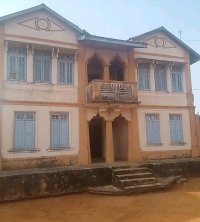
Here is my grandfather's house in Esure. When this house was commissioned in 1955 it was a masterpiece of art, landmark and status symbol of the owner. It announced the owner as a very wealthy man in the community.
It is a 12-room affair sitting on about 4plots of land. When my grandfather moved into the house, he took two rooms above as his parlour and bedroom, gave a room to each of his three wives and ensured that they all lived downstairs. The balance of the four rooms upstairs were taken by his children whom he ensured didn't cohabit with their mothers. He gave the balance of the three rooms downstairs to relatives whose children lived upstairs with his own children.
By ensuring the children lived with him upstairs he minimized the influence of their mothers on them and engendered childhood bonding amongst all of them. It was very common to discover that amongst the siblings there was much greater unity between children of different mothers than those of same mothers.
Our fathers grew up with that love amongst themselves and their cousins with whom they all lived. The house was totally filled up. Everybody lived in and around Esure.
Today, there is just a SOLE OCCUPANT in this house, my 86-year old uncle. He lives there all by himself! All the children are scattered all over the cities taking their mother with them,leaving the poor old man with a visiting house help.
I was talking with him just this morning. I told him: " Baba, do you know that your own Grandfather, Pa Sunmola Babaegbe, didn't live this way?. When he was about in his late 70s the man took a young wife to make his number 6. By the time he died at age 94, he had children who were just toddlers. At every point in his life he had a wife and children all hovering around him!" That was SENSE!
I went on to remind him: " Your own father, Imam Yoonus Adetayo, though he had three wives, in his old age he was practically alone. One of the wives died before him, the other, my own grandmother was almost permanently living with her children and the last wife was just about doing the same thing."
My grandfather lived till 90years of age but he himself was almost always alone in this house save for one of his daughters who on account of some circumstances lived in the house with him. That daughter was his saving grace otherwise he could jolly well have died a lonely man! What kind of rubbish is that? You can then imagine what will happen to men of my generation, today's born-again lovers of monogamy.
But there is more. What happened to BONDING?
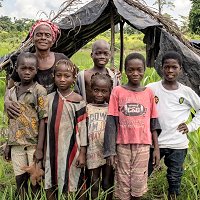
"Retirement will come the day I’m buried": Grandmothers are left holding the baby when young people are abandoning their villages and children for the bright lights, leaving their mothers to pick up the pieces. For Bokwaya Angel Naonou, a 57-year-old granny, the education of her six grandchildren is what matters most, but she has to borrow money to enrol them in school.
In the great movements of population going on around the globe, there are 300 million people living somewhere other than their country of birth – and three times as many have migrated within their own country. But for every migration there are those left behind and most of them are women and children.
The city of Daloa and its surrounding villages in western Ivory Coast encompasses all of this. An important regional hub, the trade in cocoa and coffee made Daloa prosperous and provided people with a relatively comfortable life. Small landowners could employ people to work the land for them and extend their fields to the forests. Labour came from elsewhere in Ivory Coast and from Burkina Faso, Guinea and Mali, but also Ghana and Liberia. Ivory Coast is home to between 4 million and 5 million foreigners, more than a quarter of its population.
In the countryside, where it was once possible
for a family to live off their land and afford seeds and fertiliser, send
children to school, pay for a medical visit, and be able to save a little,
hard choices now need to be made between shoes for the children or pesticides
to guarantee a harvest. Where there was once joy at seeing crops grow,
now there is a fatalism: pray for the best, expect the worse, as the seasons
are disrupted and the erratic fluctuations of commodities make every decision
a gamble. Hunger has taken hold across Africa. We need a new approach
to tackling its causes.
In the hamlets of the Sassandra-Marahouй district you can see what the new economic reality means – people ranging in age from teenagers to their mid-30s are absent. The village elders have a word for this exodus, l’aventure: younger people who have left the strictures of village life for the city, jobs, anonymity and freedom. But they have also left their children.
In village after village, grandmothers are bringing up four or five or six grandchildren, in some cases great-grandchildren, too. Often the parents slip away in the dead of night, without warning, leaving their children behind. The grandmothers become sole breadwinners, toiling in fields in heat and dirt. It’s hard to imagine the physical toll as well as the impact on their emotional and psychological wellbeing as they again feed and raise children, but without the vitality of their youth.
These women have to rewrite traditions set by their ancestors. A life that once followed the seasons, gave an abundance of crops, provided a retirement plan, has changed irrevocably in the face of the climate crisis.
A certain company has a
tradition of holding a party and a lottery every Christmas Eve.
The rules of the lottery draw are as follows: each employee pays ten dollars
as a fund. There are three hundred people in the company. In other words,
a total of three thousand dollars can be raised. The winner takes all
the money home.
On the day of the lottery draw, the office was filled with a lively atmosphere. Everyone wrote their names on a slip of paper and put them in the lottery box. However, a young man by name Karl, hesitated when he wrote. Because he thought that the company's cleaner has a frail and sickly son who was going to have an operation recently, but she did not have the money to pay for the operation. This made her very troubled.
So, even though he knew that the chance of winning was slim, with only a three percent chance, Karl wrote the name of the cleaner on the note.
The tense moment came. The boss stirred the slips in the lottery box, and finally drew out a note. Karl also kept praying in his heart: I hope the Cleaner can win the prize...Then the boss carefully announced the winner’s name. A miracle has happened!
The winner turned out to be the Cleaner! Cheers broke out in the office, and the Cleaner hurriedly came to the stage to accept the award. She burst into tears and said movedly: I am so lucky! With this money, my son has hope to live !
As the party was in progress, while thinking about this "Christmas miracle", Karl paced to the lottery box. He took out another piece of paper and opened it casually. The name on it was also the name of the Cleaner ! Karl was sincerely surprised. He took out several pieces of the slip of papers one after another. Although the handwriting on them were different, the names were all the same. All of them were the names of the Cleaner ! Then Karl's eyes were red - tears of joy. He clearly understood that there is a Christmas miracle in the world, but the miracle will not fall from the sky. People are required to create it by themselves!
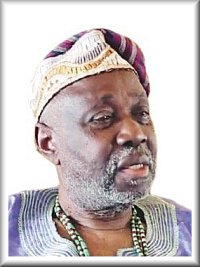
KINDLY READ THE STORY OF
PROFESSOR WANDE ABIMBOLA, PROFESSOR OF IFA;
FORMER VICE CHANCELLOR, OBAFEMI AWOLOWO UNIVERSITY, NIGERIA.
FORMER SENATOR, FEDERAL REPUBLIC OF NIGERIA
Prof. Wande Abimbola is a man of many parts. He was born into the family of a famous Babalawo. He was a Senator of the Federal Republic of Nigeria. He has travelled far and wide and his network of friends is awesome. Despite all his exposures, the 88-year old Babalawo has retired to Oyo town in South West, Nigeria. He lives in the house his father built 102 years ago.
HIS CHILDHOOD EXPERIENCE
“I was born in the premises where I live now. My father’s apartment is
in the front and I was born in one of the houses in the premises on December
24, 1932. But I did not know the exact date of my birth for many years.
“When I was at Baptist Boys High School, now Olivet High School, Oyo,
our class teacher one day asked for the date of birth of everyone in the
class, so I had to travel seven miles to our village to ask my parents.
They said they did not remember the date. They said that they could not
recall the date because four other boys had been born before me and they
did not survive beyond few months. The Yoruba refer to them as Abiku;
that is children who don’t plan to stay long because they were probably
on a visit.
“I was seen as an Abiku too because they did not know if I would live.
That was why they did not remember any detail pertaining to my date of
birth.
“Several decades later when I was the Vice-Chancellor
of the University of Ife, now Obafemi Awolowo University, I came home
to see my mother, who died 11 years ago at the age of 107, and my elder
sister, who is still alive. My sister said I was born on a Saturday. She
said that Saturday happened to be a Christmas Eve because on that day,
some Christians in the next village were dancing. “I thought that could
be a clue to my date of birth. When I got back to school, I asked the
librarian to find a Saturday in the 1930s that fell on a Christmas Eve.
He said there was one in 1932 and another one in 1938. I knew it could
not have been 1938 because I started school in 1945. I could not have
gone to school at the age of six at the time. You had to be at least eight
years old. I came to the conclusion that I was born on December 24, 1932.”
EDUCATIONAL BACKGROUND AND WORK
“I was admitted to the University College, Ibadan, now University of Ibadan,
in 1959. I was a state scholar. At that time, the best students in each
faculty enjoyed full scholarship. They would also pay stipend to your
parents and three children. That was in the colonial times. I studied
History. “One of my classmates was Prof Oloruntimeyin. Before
my final examinations, there was an advertisement for the employment of
a junior research fellow in Yoruba Study at the university. Yoruba as
a course was not available at the time. When Oloruntimeyin saw the advert,
he advised me to go for it and I was selected.
“One of the criteria for the appointment was
a Master’s degree certificate in either divinity, anthropology, English
or literature. I was not qualified in any way.
A week before the interview, the director of the Institute of African
Studies, the late Prof R.G Armstrong, dropped a note in my pigeon hole
at Melamby Hall. He wanted to see me. When I got there, he said that he
saw my application and asked why I applied when I did not even have a
first degree. “After more than one hour of discussion, he was impressed
with me and said he would short-list me. There were 11 people who had
Master’s degree that were invited. I was called in first. When I discovered
that the interviewers did not know anything about the subject, the session
became a lecture and I lectured them. Four days later, I got a letter
of appointment and a note for me to choose an accommodation among the
houses available on the campus. That was how I became a junior research
fellow in Yoruba Studies even before I wrote my final first degree examination.
“I occupied the position for more than two years. While doing it, I started wondering why there was no degree programme in Yoruba. There was a friend who had scholarship to study Linguistics in Birmingham. We discussed the issue when he arrived back in Nigeria and we decided to start a degree programme in Yoruba. But before that, I had to travel to the US to do my Master’s degree in Linguistics. My plan was to return to Ibadan to start the Yoruba programme but on my return, I went to the University of Lagos. I met Dr Adeboye Babalola and another person there and we started a degree programme in Yoruba. “I later did my doctorate degree on Ifa.
There were just three of us that bagged the certificate in 1970 at UNILAG and it was the first time the school would offer doctorate degree. The three of us did different programmes.”
YET TO KNOW HIS DATE OF BIRTH
“On the date that the teacher asked for our birthday, he said it could
be at the back of our parents’ Bible but my parents were not Christians.
I just told him that I was born on June 26, 1936 when I could not get
the date. I used that date until after I became the Vice Chancellor at
OAU.”
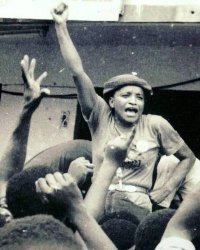
A triumphant story of determination defeating adversity
Photo of Ellen Johnson Sirleaf after her release from prison in the 1980s. Ellen was Secretary of State for Finance between 1972 and 1978, then Minister of Finance between 1979 and 1980.
That same year, Samuel Doe carried out a coup and had incumbent President William Richard Tolbert assassinated at his home and most of the ministers on a beach. Ellen Johnson Sirleaf survives because she is a woman and because the new president cannot totally decapitate the bureaucratic apparatus.
She nevertheless manages to go into exile and then returns later, declaring that she wants to campaign against the president, which leads her to be threatened with death again.
From 1985, she was sentenced to ten years in prison for opposing the military regime of Samuel Doe, but was allowed to leave the country shortly after. Her political opposition earned her the nickname "Iron Lady".
She become the first woman elected by universal suffrage as the head of an African state in 2006. She is a co-recipient of the Nobel Peace Prize in 2011.
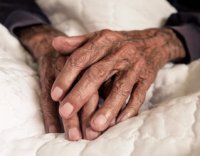
A shocking story - always remember that old age is a reality
We will call her 'Mama'. She was 73 years old
and a UNTH nurse and retired in 2007. She was not childless. Gave birth
to 6 children but 5 surviving children (4 boys and a girl). She raised
all her kids and they're all professionals. Money was not an issue. She
was widowed in 1999.
Her only daughter lives in Lagos ( in a bad marriage since her husband
doesn't allow her to bring her mum over). Her three sons live abroad.
Her first son is a medical doctor in America and only calls once in a
while. The only son in Nigeria lives in Enugu and his wife pays her a
visit on Sundays but stopped for reasons not revealed.
Her only sister who is older than her but still strong in health visited, found her in a bad state and decided to take her with her to her Umuahia home. She had signs of dementia. She suffers from diabetes and weak bladder. So the urine smell complained by people are well understood.
Mama was found dead close to an opened fridge.
Mama's sister said her only daughter had only called twice since she came to Enugu. Mama's sister wants to bury her sister on her own and mourns her quietly. Her kids are now back crying and saying they will give their mother a befitting burial.
A woman that raised five children should not
have suffered like this. Remember that one day......
- The bones and muscle will be WEAK
- The eyes might lose its functions
- The bladder might be weak and you cannot contain your urine.
- Cash flow will seize.
- Your legs cannot carry your weight.
- Your hands might not hold things due to parkinson or rheumatism
- Your mouth will smell because you cannot brush it well.
- Your brain might stop functioning. Dementia and loss of memory can happen.
- You cannot even take care of your personal care ......
It is called OLD AGE characteristics.
Life can happen and your children will be very busy with their lives that
your care will be relegated to STRANGERS.
Children are NOT retirement benefits.
Old age is a reality!
ACCORDING TO MARY SLESSOR:
Did she really stop the killing of twins in Calabar?
By Richard Duke
In 1849 (when Mary Slessor was 1 yr old) Consul
Beecroft in agreement with King Eyo II and King Archibong I banned human
sacrifice and the killing of twins in Old Calabar. The Obutong (Old Town)
people broke the deal with the Colonial Administration and as a consequence
were bombed out of existence by Consul Beecroft in 1855 (with the connivance
of the Colonial Army).
 On 18 January 1855
(when Mary Slessor was 7 yrs old) King Duke Ephraim and some other Efik
Chiefs entered into a further Agreement with the British Consul Hutchinson
to abolish the Murder of Twin Children in Old Calabar.
On 18 January 1855
(when Mary Slessor was 7 yrs old) King Duke Ephraim and some other Efik
Chiefs entered into a further Agreement with the British Consul Hutchinson
to abolish the Murder of Twin Children in Old Calabar.
Why is Mary Slessor
who came to Calabar in 1876 (21yrs after the aforementioned Agreement)
erroneously ascribed to as the person who stopped the killing of twins
in Calabar? She never had the Missionary mandate or British colonial infrastructure
to enforce the stopping of the killing of twins by herself.
It’s one thing
to pick up endangered twin babies and give them sanctuary, and it’s another
thing getting to the core of the matter by engaging with the Kings and
Chiefs of Old Calabar to bind them to an enforceable Agreement to declare
a ban on the abhorrent practice. The people were stubborn and stuck to
their superstitious beliefs but it took the military intervention to force
them to comply.
Don’t forget that
Mary Slessor only came to Calabar in 1876. On arrival she met Rev Edgerley,
Rev Hope Waddell and Rev Hugh Goldie who were already involved in Missionary
work in Old Calabar 30 years before Mary Slessor touched her foot on Calabar
soil.
In fact it was
Rev Hugh Goldie who spent nearly 50yrs in Calabar who taught a young Mary
Slessor how to speak Efik Language as part of her induction.
 In order to consolidate
the efforts of the Missionaries in Calabar the British Consuls persuaded
the Efik Chiefs to sign an Agreement to stop the killing of Twin children.
In order to consolidate
the efforts of the Missionaries in Calabar the British Consuls persuaded
the Efik Chiefs to sign an Agreement to stop the killing of Twin children.
Rev Edgerley and
his wife were recorded as having carried out the first Twin saving act
in Calabar in Old Town (Old Obutong) in 1852. When the Old Town people
continued the practice in addition to sacrificial killings, Rev Edgerley
got some British Captains to bomb the place. This struck the fear of God
into the other Efik chiefs.
To the credit of
Mary Slessor she rescued twins and created a sanctuary for them to stay
with her; but this was mainly done in Okoyong where she was also the Vice
President of the Native Court and used her position to enforce the ban
against the murder of twins.
Mary Slessor may
have stopped it in Okoyong in 1876 but surely not in Calabar. Please let’s
update our History books. So next time you are asked the question “Who
stopped the killing of Twin children in Old Calabar?”; the answer is,
“It was stopped through the enforcement of a voluntary agreement signed
between Duke Ephraim on behalf of the Chiefs of Old Calabar and the British
Consul Hutchinson in January 1855”.
Curated from the Efik Historical
Research Forum®?